Basement Floods in Long Branch? Step by-Step Action Plan
If your basement is taking on water right now in Long Branch, you need answers in minutes, not hours. This guide gives you the exact sequence to follow before, during, and after professional help arrives. Long Branch Water Restoration has handled flooded basements across Central Indiana since 2018, and the steps below come from real jobs, real insurance claims, and IICRC field standards. We are BBB A+ rated and IICRC certified, so what you read here matches what our crews actually do on site.
Quick Answer: Shut off power to the basement if it is safe to reach the panel, stop the water source, document everything with photos and video, call a licensed restoration company within the first hour, and contact your insurance carrier. Do not wade into standing water until power is confirmed off. Mold can begin growing in 24 to 48 hours, so professional water extraction and drying should start the same day. If we cannot help your specific situation, we will tell you directly and point you to someone who can.
The First 15 Minutes: A Story From the West Side
A Long Branch homeowner named Derek called us last March around 11 p.m. His water heater had split a seam and dumped roughly 50 gallons across his finished basement before the auto shutoff kicked in. The first thing our on call tech asked him was not about the water. It was about the breaker panel. Derek had a power strip submerged behind his entertainment center, and the basement lights were still on.
If you take nothing else from this guide, take this. Before you step into standing water, kill power to the basement at the main panel. Derek shut off two breakers, grabbed a flashlight, and waited on the stairs until we arrived 38 minutes later. He did not get shocked. He did not lose his furnace. He did lose the bottom 12 inches of drywall on three walls, which is normal and expected.
What Derek did right, beyond the breaker panel, was he resisted the urge to start grabbing wet boxes from the floor. He had a stack of old tax records and his daughter's college art portfolio sitting in cardboard bins along the wall. Cardboard wicks water vertically at roughly an inch every 10 minutes, and the contents were already compromised. When our crew arrived, we photographed everything in place, then sorted salvageable from non salvageable on a tarp in his garage. That documentation alone added about $1,800 to his content claim.
Drying the Structure: The 72 Hour Window
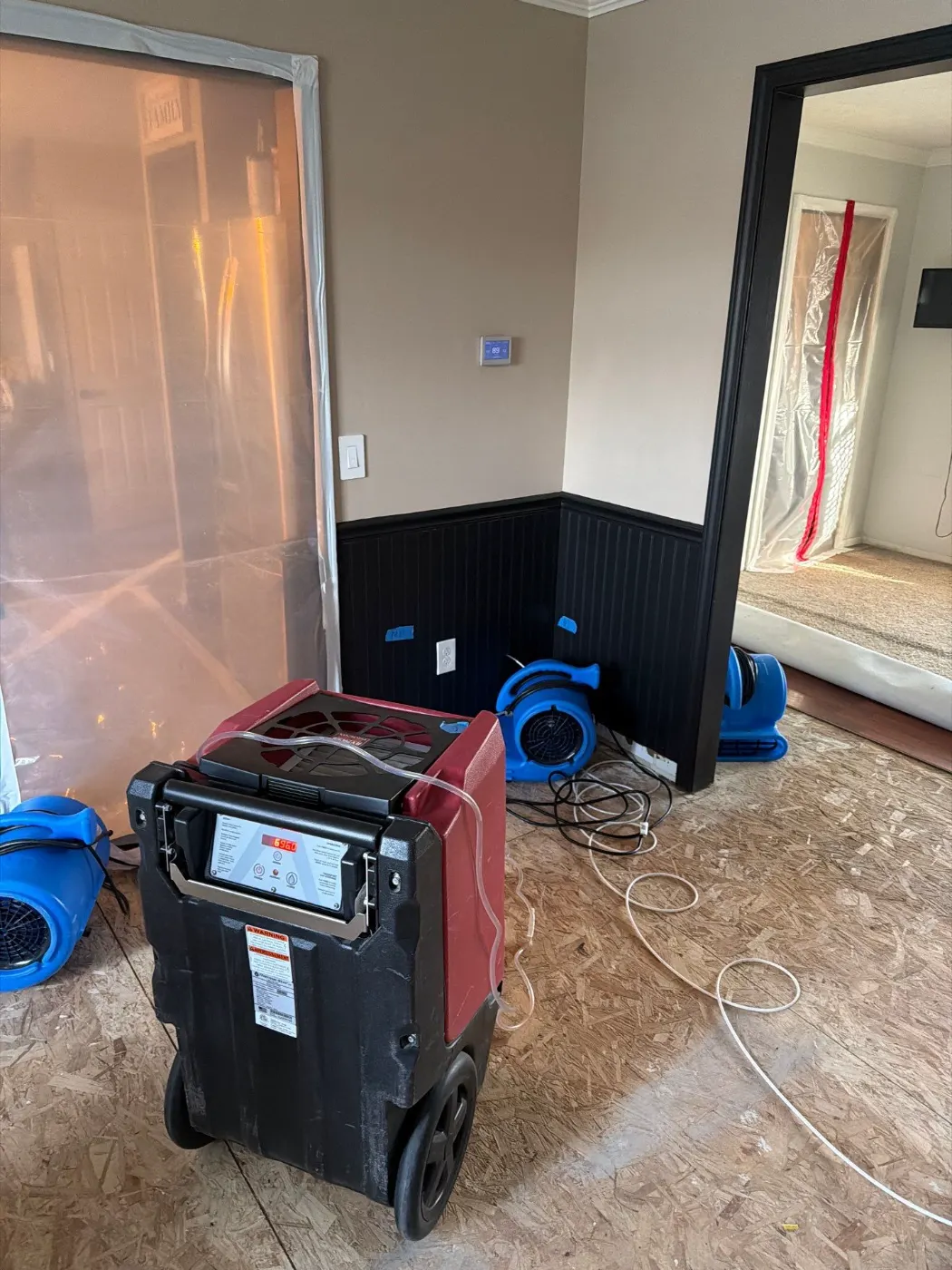
One of our regular property manager clients owns six rentals around Long Branch. Last July, one of his tenants left a hose bib open and flooded a finished basement to about 4 inches. We extracted that night, then set 14 air movers and 3 commercial dehumidifiers. By hour 72, our moisture meters read below 16 percent on the bottom plates of every wall. No drywall replacement needed below the 24 inch mark. Total invoice was $4,180. If he had waited a week, the rebuild alone would have run $11,000 to $14,000.
That is the difference professional drying makes. The full drying timeline article walks through what to expect day by day.
A Note on Insurance and Cost
A Long Branch family I worked with in October had a $2,200 deductible and a $9,400 mitigation invoice. Their insurer covered everything above the deductible because we documented moisture readings, photographed every affected material, and submitted a Xactimate formatted scope on day three. The homeowner did not lift a finger on paperwork. That is what a professional restoration company should do for you, and it is built into our process at every job.
One last thing on coverage. Standard homeowner policies in Long Branch cover sudden and accidental water events like a burst pipe or failed water heater. They typically do not cover groundwater seepage or sewer backup unless you carry a specific endorsement. We had a client in February who assumed his policy covered a sump pump failure. It did not. He had declined the $58 annual rider three years earlier, and his out of pocket came to $7,600. Pull your declarations page this week and read it. If you do not see a sump pump and sewer backup endorsement, call your agent Monday morning. It is the single cheapest insurance decision a basement owner can make, and Long Branch Water Restoration has watched too many families learn that lesson the expensive way.
What You Should Actually Do Right Now
If your basement is flooding in Long Branch as you read this, here is the short version pulled from every job above:
- Kill the power to the basement at the main panel before you step in any water.
- Identify the source. Shut off the main water valve if it is a supply line, or stop using fixtures if it is a sewer backup.
- Take photos and short videos of everything before you move a single item. Insurance adjusters want timestamped documentation.
- Move undamaged contents up and out, but only if the water is clean Category 1.
- Call a certified restoration company. Do not wait until morning. The 24 to 48 hour mold window does not care what time it is.
Extraction: Why Volume and Speed Matter
I think about a young couple in a starter home who tried to wait out a flooded basement over a long weekend. Their sump pump failed Friday night. They thought they could rent a pump from a hardware store Saturday morning and handle it. By Sunday, the water had been sitting for 38 hours, the drywall had wicked moisture up to 22 inches, and mold spores were already colonizing the back of the baseboards.
Here is the hard number you need to know. Mold begins active growth between 24 and 48 hours after materials get wet. That is not a marketing claim. That is the standard published by the IICRC and reinforced by every insurance adjuster we work with. Our extraction trucks pull between 100 and 200 gallons per hour depending on access. A homeowner shop vac pulls maybe 8 to 12 gallons per hour and burns out the motor doing it.
You Do Not Have to Figure This Out Alone Tonight
Every story above started with a phone call from someone who had never dealt with a flooded basement before. None of them knew what Category 2 water meant. None of them owned a moisture meter. All of them came out the other side with a dry, restored basement because they made one phone call early instead of waiting. Long Branch Water Restoration has been serving Long Branch and the surrounding central Indiana area since 2018, we hold IICRC certification, and we maintain an A+ BBB rating because we tell homeowners the truth even when it costs us a job. If your basement is wet right now, call us. If you are not sure whether you need us, call anyway. We will tell you straight.
Identifying the Water Category Before You Touch Anything
Another homeowner in Long Branch, a retired nurse named Patricia, made a mistake we see constantly. Her sewer line backed up during a heavy May storm and pushed maybe two inches of dark water into her basement guest room. She spent 40 minutes trying to mop it up with bath towels before calling us. By the time we arrived, she had cross contaminated her laundry room and was running a fever the next morning.
Sewage backups are Category 3 black water. You do not clean these with towels, a shop vac, or a rental carpet cleaner. You evacuate the area, close the door if possible, and call professionals. Our sewage cleanup crew showed up with PPE, antimicrobial foggers, and a truck mounted extractor that pulled 180 gallons in under two hours. Patricia's insurance covered the full job because she stopped trying to DIY it and documented everything. If you are unsure what category your water is, the water category breakdown is worth the three minute read.
One detail worth adding from Patricia's job. The towels she used went straight into a contractor bag and out to the curb. Anything porous that touches Category 3 water (towels, rugs, upholstered furniture, mattresses, particle board) is generally not salvageable under IICRC S500 guidelines. Trying to launder sewage contaminated fabric in your home washer can contaminate the machine itself, which is a $900 mistake on top of everything else.
Frequently Asked Questions
How fast does Long Branch Water Restoration respond to a flooded basement in Long Branch?
Long Branch Water Restoration dispatches to Long Branch basement floods within 60 to 90 minutes of your call, 24 hours a day. Faster response means less drywall damage and a lower final bill.
Will homeowners insurance cover my flooded basement?
It depends on the source. Sudden internal failures like burst pipes are usually covered. Groundwater and sewer backups need specific endorsements. Long Branch Water Restoration helps Long Branch homeowners document the loss correctly so claims get approved.
Can I just use fans and skip professional drying?
For under 100 square feet of clean water caught in the first hour, yes. Anything larger or older than 24 hours needs commercial dehumidifiers to prevent mold and structural damage.
How long does it take to dry a flooded basement?
Most Long Branch basements dry in 3 to 5 days with professional equipment. Concrete, framing, and insulation can extend this to 7 days if saturation is deep.
What if the water is sewage or storm runoff?
Treat it as Category 3 and do not handle it yourself. Long Branch Water Restoration uses containment, PPE, and antimicrobial protocols required by IICRC S500 standards for contaminated water losses.
Have a restoration question?
Our IICRC certified Long Branch crew is ready to help. Free assessments, estimate based on what we can sees, no pressure.